
#85: The Player [dir. Robert Altman, 1992]
Fuck Hollywood, now more than ever!

If the events of the last few years have proven anything about the entertainment industry it’s that nobody seems to hate movies more than the people who make them. I don’t mean the writers, directors, actors, or numerous crafts people responsible for their creation, but rather the studios and executives who fund their work. David Zaslav of Warner Bros. would rather shelve finished projects and collect tax breaks instead of release them to turn a profit. Netflix’s Ted Sarandos has spoken repeatedly about his lack of love for the theatrical experience. Those two along with their peers from the other major studios decided to burn production for nearly six months rather than negotiate in good faith with either the writers or actors in order to ensure that everyone can make a fair living in the industry. Every movie seems to be a sequel or a reboot or a remake, based on existing IP to reduce the risk that people might not be interested enough to watch it. And while a few gems still sneak through that filter, such as Dune, the vast majority feels rote and vapid. Even the Marvel superhero films, once at least enjoyable at their worst, have become stale and uninteresting.
But here’s the dirty secret – it’s always been this way. Hollywood, the business, has forever been reliant on popular stories and well-trod material. The Wizard of Oz is the third adaptation of the Baum novel. Ben-Hur and The Ten Commandments were each made twice by the same producer. A (bad but fun) remake of King Kong was made in the 1970s purely to capitalize on the new World Trade Center towers that had just been erected in downtown Manhattan. To say that Hollywood is just now out of ideas, scraping the bottom of the barrel for things they’ve already done rather than try something new is ludicrous and false. What is true, however, is that audiences at large have been less willing to shell out for the new ideas rather than the familiar, and that has led to the increased push to milk as many cash-cows as possible until they run dry (see: Star Wars).
It’s not the first time audiences have rebelled against what the studios want to feed them, most notably in the New Hollywood era of the late-1960’s through early-‘70s and the indie boom of the early-‘90s. It’s only when executives have no clue what the people want to pay to watch that they allow themselves to trust the actual artists behind the movies themselves, each time leading to new generations of writers and directors using the temporary freedom to explore new concepts and techniques and making excellent, challenging films as a result. The New Hollywood is most known for the film school brats (detailed more in my essay on Blow Out), but there was an older filmmaker who emerged as well, someone who had toiled away directing television and industrial films until finally getting a break adapting a popular anti-war satirical novel called “M.A.S.H.”: Robert Altman.
Robert Altman quickly gained himself a reputation, and not exactly a good one. Sure, 1970’s M.A.S.H. wasn’t just a hit, but ended up being the highest-grossing film of the year and was very quickly re-imagined as a network television series (one that would go on to have the most watched series finale of all time). Altman, however, saw none of the proceeds from that – he infuriated the studio so much that they refused to include him in any future contracts related to the property. Instead, he had to ride on the film’s success solely to book future projects, many of which became beloved and critically acclaimed classics but none ever came close to making the money that M.A.S.H. did. Still, he had a few friends including executives at Fox who would give him a first-look deal and produce whatever he wanted from 1976-1980. By the end of the decade, though, the studios had fully reasserted their control and directors would have to once-again play ball in order to get funded. Robert Altman refused.
After a fruitful ‘70s, Altman all but disappeared from pop culture. He still made films, mostly adaptations of stage plays that he had directed both on and off Broadway, and even returned to television for a hysterical mockumentary collaboration with “Doonesbury” creator Garry Trudeau for HBO called “Tanner ‘88”. Much of this work was well-regarded by critics and showed modest results, but they were conspicuously complex and uncompromising in the face of Hollywood preferring simpler, easy-to-digest stories. Where most other New Hollywood directors made concessions and took for-hire jobs to stay relevant, Altman maintained his stance on film as art first and foremost, refusing to do anything he didn’t want to do with his full heart. He settled his life down a bit, severely reducing his drug and alcohol intake, and graduated from the untamable lion into the lovable curmudgeon. If the rest of his days were spent making small, character focused films that got relegated to TV then so be it. He’d launched an empire in “M.A.S.H.” and been nominated for numerous awards. That’s far more than most of us could ever want out of our careers.
But here’s the funny thing – careers are long, and he stuck around just long enough to see the next sea-change coming for Hollywood. The studios, it seemed, went a bit too far pushing their (relatively) simple, loud, and expensive movies. Audiences were once again tuning out, with new directors such as Spike Lee and Steven Soderbergh exploding on the scene, making masterpieces out of pocket change and dreams. By 1990 the ‘80s studio revival collapsed, and it was clear that those in charge would need to experiment once again to stay relevant. Many of the New Hollywood directors who played ball took advantage, returning to the uniqueness and complexity that made them famous in the first place. Most of the ‘80s directors began to fall off, finding it harder to connect with modern screenplays and audiences alike.
That same year, Robert Altman was set to debut his latest effort, the made-for-TV movie Vincent and Theo, starring Tim Roth, about Vincent van Gogh and his brother. What would have been viewed as an oddity and intriguing small drama just a few years earlier was now discussed as a return to greatness for the old man, the veritable hit that had eluded him for so long. Predictably, the studios started calling again – it was possible that this once-great director would tap back into the zeitgeist like he did twenty years earlier, when he mined comedy out of abject tragedy and horror. This time around, however, Robert had a different target in mind for his knife-sharp ire and wit. He’d recently read a novel about a film studio executive who killed a writer and got away with it, reminding him instinctively of the men he’d battled his whole career to get his vision to a reality. He’d outlasted the studios, and he was ready to take them down as publicly as possible, and he knew they had no choice but to let him. Despite a few arguments surrounding the casting of Tim Robbins in the lead role (old habits died very hard with Altman), he secured the funding and made that film that would earn his first Best Picture and Best Director Oscar nominations since 1975’s Nashville.
On April 10, 1992 Robert Altman’s The Player debuted in theaters, and a whole nation got to watch a master filmmaker pants his entire industry (with the help of a lot of very famous friends).
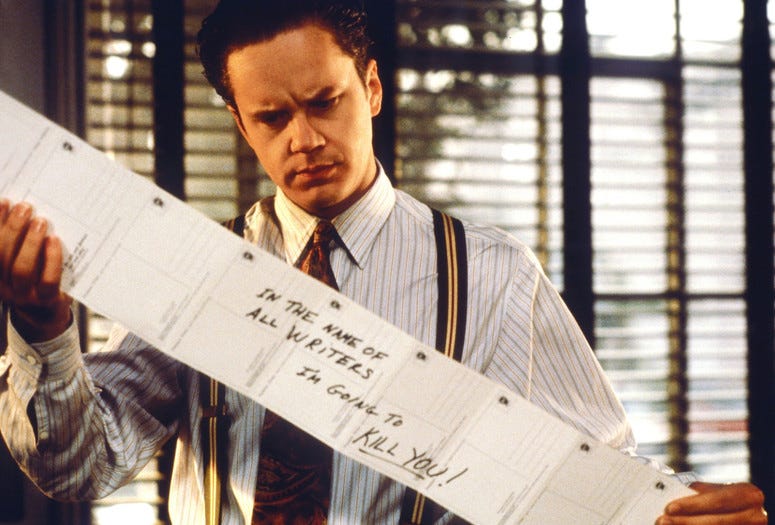
In a truly ironic twist, authorial intent for The Player seems uniquely important for a story in which the writer is literally murdered. The story follows hapless studio executive Griffin Mill (Robbins) who is being threatened by a disgruntled but anonymous writer via increasingly violent postcards. In attempt to track down the culprit he believes he finds the man responsible – David Kahane (Vincent D’Onofrio). After attempting to sign Kahane to a development deal as placation fails, he instead drowns the writer behind a movie theater and spends the rest of the film trying to get away with it. Of course, he got the wrong guy, and the man threatening him is still at large. His job is threatened by a newly hired superstar exec from Fox, Larry Levy (Peter Gallagher). He attend’s Kahane’s funeral and begins a romance with his girlfriend, June Gudmunsdottir (Greta Scacchi). On paper it’s fairly straightforward.
One could view the entire tale metaphorically as well, almost to the letter. The Player is a story about how the studio kills the artists, gets away with it in plain sight, and corrupts everything they love and hold dear. June is an artist herself (though her actual talent is dubious), a woman who’s art is intentionally unplanned and improvised, throwing paint on walls and taking pictures of whatever she feels like in the moment. As a person she’s flighty and opaque and excitingly beautiful, the kind of person both a tortured intellectual writer and a vapid empty businessman would fall for thinking they’re deep enough for the two of them. As a symbol, she is the artistic id that one seeks to harness as their muse and the other seeks to exploit for profit.
There is a paradox inherent to filmmaking, an art medium that requires massive amounts of funding to produce anything of quality. One person can write and perform a song on a guitar by themselves, an author can work in solitude for months at a computer or typewriter, and a painter only needs their canvas and paints. A filmmaker, however, needs a team of people to complete any project – every film, at minimum, needs a director, a writer, an actor, a camera person, an editor, a sound designer, a production designer, and a costume designer. Some of those jobs can be done by the same person, but not all. Each person involved needs money, food, and stability for the days, weeks, and sometimes months of filming. No matter how true an artist wants to be to their work, if they make movies they require funding to complete. Funding, as we know, was the one thing that Altman struggled to get for so long.
For those of us who love movies it can be difficult to reckon with the reality. We want movies that show the human condition in its purest form, but we also want entertainment. We love when our favorite movies make a lot of money or win awards, but we also recognize that those are not and should not be the end goal of making movies, nor do they truly represent quality. We also lament when the types of films we love are no longer made because the people in charge of the money don’t believe in their worth anymore, especially mid-budget movies for adults (of which The Player is a perfect example). We rightly blame the studios and executives for making decisions with their wallets rather than their artistic hearts (assuming they have them). But it would be false to claim they aren’t ultimately running a business, and even if we disagree with their choices they aren’t being capricious. They’ll kill the movies we love to keep their jobs – they get away with murder.
The Player is an uproarious comedy at every turn, and some of the funniest scenes involve the police investigating Griffin, led by Detective Susan Avery (Whoopie Goldberg). We first see her holding one of the studio’s Oscar trophies, remarking on its heaviness (coincidentally, or intentionally, she was fresh off her win for Ghost while filming this). She remarks on the many movie posters around the lot (all of which made by a different studio and none of which they would have ever greenlit). Later, at the station, she and the other officers discuss going to see and quoting classic movies, like Freaks (one of us, one of us). Griffin and the other studio heads talk about their love of movies (though they repeatedly make it clear how much they don’t really care about them) , but it’s the police who demonstrate they’re the actual film lovers. They know Griffin did it, but they can never prove it enough to lock him away. They are the rest of us, looking on as the studios kill our favorite movies.
Speaking of killing, in between interviews with the police and dates with the artist Griffin hears a pitch from director Tom Oakley (Richard E. Grant) and his producer Andy Sivella (Dean Stockwell) for a film called Habeas Corpus that most of us would clamor for, but the studio exec can’t see the value in – it’s about a woman falsely accused of murder who, unlike Griffin, will not get away with it. She dies in the gas chamber while the man who loves her doesn’t save her in time, because that’s reality. The director and producer want no stars, just talent. Griffin, on the other hand, is reluctant to make a picture he thinks is too much of a downer, something that won’t well. Instead of pawns it off on Levy, knowing if it fails Larry will take the fall but if it succeeds Griffin will still be a hero for bringing it in. Even a good movie gets made out of cynicism.
By the end of The Player, Griffin gets off because the lone eyewitness accuses one of the detectives of being the killer during a police lineup and rather than being put behind bars is instead promoted to becoming the head of the studio. When we see Habeas Corpus, now completed a year later, it’s been bastardized. Rather than no stars we see Julia Roberts and Bruce Willis, and instead of the sad and poignant ending we get Bruce barging into the execution room with a shotgun and carrying his love off into the sunset – the original ending tested poorly so they changed it, that’s reality. June and Griffin are now an item and expecting a child, Kahane long forgotten. The postcard writer, however, has a pitch that the studio just has to make – what if there was a movie about a studio exec who killed a writer and got away with it? It’s called The Player.
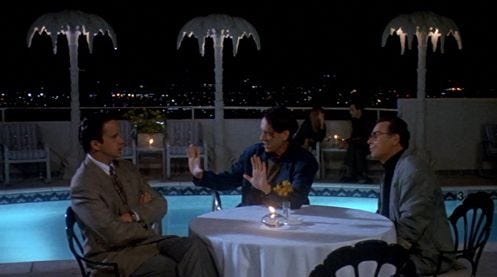
For all the talk of Robert Altman being a known asshole, he certainly managed to make a lot of famous friends. Save for a few notable exceptions, Altman’s battles were usually reserved for the money men he was forced into business with and the people he felt betrayed him. Despite his reputation, he managed to have a regular coterie of actors and writers he would work with time and time again, forming his own quasi production company as a result. When he had an idea for a film that he didn’t have time to write, he’d send one of his friends on an assignment to get the job done. He discovered and mentored others, such as director Alan Rudolph, and by the ‘90s was viewed as a spiritual grandfather to many. So, when he wanted to make a satirical film about the evils of Hollywood, it wasn’t that hard to find people to agree to join in the fun.
The fictional cast is predictably stacked, with additional appearances from the great Sydney Pollock as a glad-handing lawyer, Cynthia Stevenson as Griffin’s original paramour, and Fred Ward as the studio’s all-knowing and all-powerful head of security. Every time an person we recognize appears there is an intentional uneasy limbo, when we don’t yet know if we’re looking at the actor themselves or a character and the joke’s on us when we get it wrong. We can zoom in on Jack Lemmon playing a piano and move over to Harry Belafonte talking to the lawyer as if they’re old friends, but we know the latter isn’t actually Pollock. It’s a great reminder that the actors we idolize and celebrate are not their characters, but real people just living their lives and doing their jobs. And as each one is accosted by the executives they summarily loathe, we laugh again and again at the incredulous faces and remarks they make once they’re out of reach.
The irony of The Player being filled with so many A-list stars is how often it reminds us that Hollywood would rather shoehorn them into as many movies as possible to draw an audience rather than find new talent. As I said before, there were disputes between New Line Cinema and Altman over the casting of Tim Robbins, who had not yet been launched into the stratosphere with The Shawshank Redemption, in the lead role. With every pitch Mill hears, particularly those in the much-lauded opening single-take scene on the studio lot, it is suggested that every female lead be Julia Roberts and every male Bruce Willis. In 1992 they were both the most sought after actors in Hollywood, but it’s worth remembering that it wasn’t even five years before that both were seen as unconventional choices in their cinematic breakthroughs. A studio once took a chance on them, and now they’re the safe picks – if only those in charge remembered that fact.
The Player is arguably the biggest success in Robert Altman’s career, the most contextually important film he ever made. Nominated for three Oscars and making back roughly 3.5X its budget, Altman proved to be a bankable director once again. He followed it up immediately with a long-time passion project, the supersized ensemble epic imaginative adaptation of numerous Raymond Carver short stories called Short Cuts. It might not have made anywhere near as much money, and only netted one Oscar nomination (for Best Director), but it was still received with massive critical acclaim and cemented his return to form. From then on until his death in 2006, Robert Altman continued to make the movies he wanted to make, and every once in a while a true gem would break through with audiences such as the brilliant Gosford Park.
Having said all of this, I get the sense that Robert Altman is not as remembered or revered as he should be outside of specific cinephile circles. When most people think of great American directors from the ‘70s or ‘90s they usually bring up his name rarely comes up, and our modern technology is mostly to blame. It used to be that, to discover an older movie, all you had to do was browse your parents VHS or DVD collection and pick what looked interesting, or peruse the Blockbuster and Hollywood Video shelves for anything new and exciting, or be stuck watching what the TV channels were playing at the time. Today, however, everything is streaming and digital rentals. Most people are just watching the specific movie they wanted to see, which is usually either something new or popular. Discovering new movies for yourself, particularly ones from decades past, requires a lot more effort than it once did. You have to look deep into a streamer’s collection, or search online for someone else’s list of recommendations, or listen to podcasts like The Big Picture or Blank Check that routinely discuss underrated or rarely mentioned movies.
Even still, you’re at the mercy of what’s available and most of Robert Altman’s filmography, depressingly, isn’t. The Player, luckily, has been on MAX I believe since the platform’s inception as has M.A.S.H., but those are probably his two biggest hits. The shockingly still relevant comedy about gambling addiction, California Split, just left Netflix, but it’s back on Amazon Prime, as is Altman’s takes on film noir with his adaptation of The Long Goodbye from the mid-‘70s and Kansas City from the mid-‘90s. But on the major streamers, that’s it. A handful are available for free on Kanopy if you have a library card, a few more with ads on Tubi, but even still roughly half his filmography is only watchable via digital rental. Three of his greatest movies, Short Cuts, Nashville, and 3 Women, are only in the Criterion Collection, not even a digital rental is available. By cobbling together funding deals and pissing off studio executives, Altman created a collection of 35 miraculous films. Because of the tangled web of rights disputes that created, however, it is unlikely many will see the digital light of day anytime soon.
I think Altman’s movies are all worth seeking out, even the ones that don’t quite work are all interesting. His view on people and the way we interact has more angles than anyone could imagine, and rarely does he not inject humor into even the darkest of tales to keep us on our toes. The Player represents his view on the industry he had to work in to make his art for a living, and the bevy of cameos suggests that he’s not alone in that sentiment. When John Cusack blows off Griffin at a restaurant or Burt Reynolds calls him an asshole behind his back, we don’t have to stretch too hard to realize they have a specific real-life person in mind. It’s easy to watch, just a few clicks away on MAX, and a perfect place to start if you’ve never seen an Altman film before.
It opens with what I believe is his signature move – an opening scene perfectly designed to lull you into a sense of security, to lower your heartrate just enough to let you enjoy whatever twists and turns the story will take without overthinking it, a sequence that lets you know you’re in good hands. In this case, it’s a single shot parading you around the backlot while Griffin hears pitches, Japanese businessmen are given a tour of the studio they might soon be purchasing, actors and writers moving from place to place like it’s just any other day, a pounding Thomas Newman score, and Buck Henry trying to sell everyone on The Graduate, Part II. This is the way movies work, it’s reality. What follows, as surreal as it may seem, is exactly what happens as well. The movies reflect our world, for better or for worse. It’s just a shame the studios have to deal with all those writers, actors, and directors.